I’m back on US soil. Suddenly I am surrounded by rudeness, impatience, judgement, disapproval, selfishness, obesity, poor parenting, intolerance, stress. Everyone criticizing everyone and everything else: assessing and sneering and glaring and rolling their eyes and huffing and muttering and shifting impatiently and making snide comments. The weather is horrible, that guy can’t drive, what was she thinking with those shoes, don’t sit there, you’re a freak, what a loser, omg I can ‘t see the tv, shut up, because I said so.
And that’s just the people physically present. Let us not forget the messages coming from the TVs, which btw are absolutely everywhere. I have learned: My hair is not silky enough. I need a better tan and a bigger TV with lots of channels. Coke; no, Pepsi; no, Coke; no, Pepsi. I should let ‘my man’ have fun this summer while I enjoy special time with the kids, at whom I will bemusedly shake my head. I am fat, and should get fit (process unspecified, seemingly involving hanging out laughing at cafes with girlfriends). I should get plastic surgery: specifically, a nose job, face lift, and botox, which are no big deal. I should go blonde(r). I should drink more, and shop at J.C. Penny, where I can create my own new individual look, which should center on floral cocktail dresses, which will make me more confident. My car should be bigger and a stick shift and I should drive it too fast, which will constitute an appreciation of fine motor craftsmanship and a fulfillment of satisfying living. I should redecorate my home in shades of green, and cook meals inspired by Nuevo-British cuisine, plus cupcakes.
In all seriousness, it’s left an absolute pit in my stomach to re-enter this world of criticism and disparagement. I know there are nice people in this country, and people who are confident and who love themselves and others just the way they are and/or for more meaningful reasons than the above. But that doesn’t change the fact that we are constantly, constantly, being told we’re not good enough. It’s only having been away from it that allows me to see the pressure and realize how it makes me feel.
Some smaller things that are taking some getting used to: warm showers. The horrifying first thing that came to mind when the warm water poured over me was that I was showering in a stream of pee (urine being the only warm liquid I had encountered in months). Even that aside, it was a rather disgusting feeling. Also: artificial sweeteners and corn syrup. They taste horrible. I had become so entirely spoiled by everything being sweetened by sugar, usually raw. Food options: all I can see is processed, sugary, fattening, and/or artificial. I long for the whole, fresh, local foods that are typical in Costa Rica, and fear I will not be able to maintain the level of fitness and digestive happiness I have effortlessly attained over the summer. Noise pollution: there are sounds of engines and machinery everywhere! And I’ve commented on this previously on this blog, but I am struck once again: American public bathrooms smell horrible, and there is the reek of man-pee throughout nearly all public spaces (like sidewalks). This is not acceptable or normal! It doesn’t have to be this way!
Now, if I were being a good make-everyone-else-happy-and-comfortable American woman, I would try to balance this blog post out with a nice palatable conclusion featuring some of the things I have enjoyed about being back home.* But I don’t want to make these truly unacceptable things above softened in any way. It’s not ok. I don’t like this culture and how it makes me feel. I’m not glad to be in this country. It leaves me with the feeling of wanting to go home. But this is supposed to be my home. And that makes me very, very sad.
*Family, potable water from the taps, air conditioning, dryers, wifi, wine.
Monday, July 25, 2011

Friday, July 22, 2011
San Jose the city
I had visited San Jose, the capital and principal city of Costa Rica, once before, on the occasion of a Tica college friend’s wedding. Memories of grime, mistrust, and exhaust gave me no reason to ever think I’d return. But though I’d assiduously avoided it during my journey towards the peninsula, I found myself this time wanting to give The City a chance to redeem itself, and so stayed there for two days on my way back home.
I wouldn’t go so far as to say I enjoyed San Jose this time around. Located in the bowl-like Central Valley, ringed steeply by volcanoes, the city is steeped in the stew of its own smog and effluvia. Narrow, unmarked, paved streets divide rows of 1-3 story buildings. Architectural styles range from the basic universal shack to modern 1960s hilarities to imitations of Spanish colonial forms almost cartoonized in their simplification. Construction materials are dominated by corrugated tin and cement blocks, with colors of rust and bold solid paints dulling the eye. Steep hills and deeply-cut drainage ditches make traversing the narrow sidewalks somewhat treacherous. Crime is high, necessitating not only constant vigilance on the part of pedestrians, but also prompting window bars and fences and barbed wire everywhere, making street scenes look like long narrow prison yards.
The city is much cooler than the coasts, which is pleasant, but its urban density and modern economy strip away almost everything I enjoyed about the culture elsewhere in the country. A third of the country’s population lives in this dense metropolitan area. Shopping malls, chain stores, business suits, fast cars, and general bustle have taken over. I am somewhat resigned to this as a necessity, though, along the lines of the cultural scapegoat: San Jose’s commerce, industry, universities, transporation hubs, etc., allow the placidity of the rest of the country to remain unaltered while providing the influx of resources that permit the country to thrive above the poverty level. It’s as if they have condensed and quarantined all of the less pleasant aspects of modernity to this valley.
The city sadly lacks the cultural institutions and opportunities that usually balance out urban frustrations. There are museums, but they are very small and sad (with the exception of the gorgeous underground Museum of Gold). There are very few music or performance venues. The visual arts are largely unrepresented. The food is repetitive and stale. There are stores, but they are uninteresting and usually are chains. And the people are similarly dull.
Overall, San Jose manages to be simultaneously boring and stressful. I think next time, I’ll return to avoiding the city again.
I wouldn’t go so far as to say I enjoyed San Jose this time around. Located in the bowl-like Central Valley, ringed steeply by volcanoes, the city is steeped in the stew of its own smog and effluvia. Narrow, unmarked, paved streets divide rows of 1-3 story buildings. Architectural styles range from the basic universal shack to modern 1960s hilarities to imitations of Spanish colonial forms almost cartoonized in their simplification. Construction materials are dominated by corrugated tin and cement blocks, with colors of rust and bold solid paints dulling the eye. Steep hills and deeply-cut drainage ditches make traversing the narrow sidewalks somewhat treacherous. Crime is high, necessitating not only constant vigilance on the part of pedestrians, but also prompting window bars and fences and barbed wire everywhere, making street scenes look like long narrow prison yards.
The city is much cooler than the coasts, which is pleasant, but its urban density and modern economy strip away almost everything I enjoyed about the culture elsewhere in the country. A third of the country’s population lives in this dense metropolitan area. Shopping malls, chain stores, business suits, fast cars, and general bustle have taken over. I am somewhat resigned to this as a necessity, though, along the lines of the cultural scapegoat: San Jose’s commerce, industry, universities, transporation hubs, etc., allow the placidity of the rest of the country to remain unaltered while providing the influx of resources that permit the country to thrive above the poverty level. It’s as if they have condensed and quarantined all of the less pleasant aspects of modernity to this valley.
The city sadly lacks the cultural institutions and opportunities that usually balance out urban frustrations. There are museums, but they are very small and sad (with the exception of the gorgeous underground Museum of Gold). There are very few music or performance venues. The visual arts are largely unrepresented. The food is repetitive and stale. There are stores, but they are uninteresting and usually are chains. And the people are similarly dull.
Overall, San Jose manages to be simultaneously boring and stressful. I think next time, I’ll return to avoiding the city again.
Tuesday, July 5, 2011
Santa Teresa, the closest town
Driving away from the ranch on the road to the south, one drives on the dirt roads (1.5 cars wide) for 20+ minutes, crossing through three streams and an often-dicey river, before coming to the tiny town of Manzanillo, population maybe 150 (a total guess), which features a partial bridge that may or may not ever be completed, a colorful and very simple public school and playing field, a small empty chapel, a poorly-supplied and overpriced small one-room grocery store, two small restaurants that are always (permanently?) closed, and a popular outdoor family bar/convenience store/restaurant where the road turns at the beach. While we drive through the village often, and occasionally resupply there, and have friends there, the town is really too small to be of any further note.
However, there is another town, a wonderful town, a town I visited at all available opportunities: after another 15+ minutes driving up and down some really pitted, washed-out, nerve-wracking, bone-rattling hills, the dirt road turns to again parallel the beach (but set in about 150 m) and you begin to see signs for hotels alongside the road. You are entering Santa Teresa, a chill tourist town of about 3000 residents.
Physically, Santa Teresa is one dusty dirt road, bordered by a turn on one end and a crossroad on the other, with a few dozen very small businesses, hotels, and homes scattered along its 3.5 mile length. The perfect beach stretches its length to the west, while a steep jungley hill ridge bounds the east about 1/10 mile inland.
The residents are largely dedicated to surfing and yoga. The beach along this small stretch of coast is rated by most of those in the know as the best surfing anywhere in Central and South America, and warm (water temps in the 90s!) azure steady curling 10’ waves do their best to live up to this claim. The yoga instructors and gorgeous open dojos are everywhere and are about 20 times better than any I’ve ever seen.
As you can imagine, with these lifestyles, all the long-term residents are distractingly beautiful: not an ounce of fat on their fit athletic bodies, very tan, casual long hair, tattooed, with minimal clothing (shirtless men in board shorts, women in bathing suits/yoga clothes). The demographics are generally young, ‘white’ to medium-brown skin, with varied national origins ranging from Ticas/Ticos relocating from San Jose to Argentines, Israelis, Americans, and the occasional European. I have not yet seen any people evidently of Asian or African descent.
These lovely people become no less lovely upon acquaintance. Everyone is surprisingly friendly, kind, and welcoming. It is the custom for even complete strangers to give a friendly smile, wave, and “buenas” upon passing. Friends are greeted with a kiss on the right cheek (unless between men, in which case a handshake/hug usually does the trick). Everyone checks in on one another and, if someone needs a hand, any passing stranger will do their best to help, be it giving a lift down the road, offering advice, giving your car a push or tow, you name it, because (as they will point out) you never know when you will be the one who needs the help, so offer it when you can.
Topics of conversation and general interest, as well as the morals and politics and priorities of most residents, align blissfully well with my own: wildlife and local plant identification and uses, local small-scale agriculture, sustainable infrastructure, experiential education, family, fitness, delicious healthy foods, life stories, ghost stories, myths. Most people work short, early days so they have half the afternoon and all evening to spend time with their loved ones and on their favorite activities: family and time is indisputably more important than money. And, unsurprisingly, people in this tiny region live longer than almost anywhere else, officially having more centenarians than all but 4 equivalent communities in the world.
Speaking of food: I already previously talked about the typical Costa Rican foods, but thanks to the international and health-conscious residents, Santa Teresa has a distinctly different cuisine culture than its surrounds. Smoothies are de rigueur. Salads and veggie sandwiches proliferate. Fresh pastas are made by Italians, pastries and expresso beverages made by Belgians, falafel made by Israelis, Thai fusion and sushi by ex-Asian-expats. Raw is very popular, organic is valued, local is the standard, homemade is assumed. The quality of ingredients and preparation is extremely high, even by NYC dining standards. Prices vary, and while less than American, prices aren’t cheap, but are well worth it.
But sadly, the town isn’t paradise, despite REALLY seeming that way at first. The main problem that Santa Teresa and its neighboring towns face is access to fresh water. The tiny town to the south, Mal Pais, gets some of its municipal water from a pipe that draws from the clear streams of the Cabo Blanco Nature Reserve, but though a similar plan is in the works for Santa Teresa to draw via an aqueduct from the Ario river (on the CIRENAS/Grew family property), there is not yet any municipal fresh water. A very few properties have wells, but these struggle to keep up with demand even during the rainy season, and go dry during half the year. Almost all residences and businesses, including the many hotels, buy their water and have it delivered by trucks. This water is transferred to private plastic cisterns, usually elevated for gravity-fed plumbing. The water is expensive, the transportation of it is energy-wasteful, and trucking in water for a fast-growing population is inherently unsustainable. It made me very grateful for the reliable (though non-potable) wells on the CIRENAS property, and for growing up with such proliferate fresh water all around all the time. Naturally reliable potable water is one of the biggest deal-breakers for any place I would want to live long-term.
Especially when you add the fact that the water trucks sometimes can’t make it to town because the roads are so bad. The municipalities do attempt road repairs and maintenance, but they struggle against massive erosion. The roads in the region are soft dirt, and it rains a LOT. They tried paving sections, but the pavement undercut and broke and eroded just as quickly as dirt, but with the added problems of having deeper cuts from faster-moving water and left-behind messy heavy sharp rubble. (I secretly love that the best engineering for the area is the most ancient: banked dirt roads with interlocked stone embankments, just like 6000 years ago.) Resultantly, the roads are narrow, deeply pitted, with proliferate and devastating potholes, deep standing puddles and washouts, and multiple river crossings unassisted by bridges. The average driving speed, even with a swanky 4WD truck with good suspension, is about 25kph/15mph. All driving times given at the beginning of this post are what it would take to drive given the optimal conditions available at this time of year. As the streams and rivers are often hugely swollen, the roads slippery or washed out or covered by landslides, the tides high, etc., the time to drive to town can regularly be stretched to 4 times as long, or often (weekly or so) become entirely impossible.
As you can imagine, this has other negative repercussions for the town and region, notable among them difficult access to emergency medical care. Though there is a competent tiny first-aid clinic in town, anyone needing anticipated medical care, such as childbirth, makes sure to stay near the larger clinic in Cobano or, much preferably, visit relatives in San Jose: Anyone needing emergency medical care, such as from a car accident, is airlifted to San Jose, only a 20 min flight away, but very expensive to access by air.
And that’s not all. There is also a very limited selection of groceries and other staple goods available for purchase in town. The quality of public education is poor: most students only receive 2.5 hours of instruction a day in highly under-resourced, understaffed rooms, and most only stay through the 6th grade. Private school options in the area are expensive, limited, and far too laissez faire even for my Montessori-loving tastes. Out of respect for the squeamishness of my American audience I won’t discuss the problems of sewage. And there is a fast and dangerous drug scene evident throughout the town, with the expected accompanying petty theft and personal safety concerns.
And yet… I love it here. Partially because of the simplicity of life. Partially because of the friends I have made who live in town, notably my co-worker Annette and her boyfriend Adam. Partially because of the food, and of course the gorgeous tropical-beach scenery. But more than anything, because of that ineffable sense of rightness, comfort, unthinking soul-relaxation, fluidity, and peace that accompany a feeling of being in a place in which one feels at home.
(Some of these pictures aren't mine: I didn't take many pictures of town, so I "borrowed" some from elsewhere on the web.)
However, there is another town, a wonderful town, a town I visited at all available opportunities: after another 15+ minutes driving up and down some really pitted, washed-out, nerve-wracking, bone-rattling hills, the dirt road turns to again parallel the beach (but set in about 150 m) and you begin to see signs for hotels alongside the road. You are entering Santa Teresa, a chill tourist town of about 3000 residents.
Physically, Santa Teresa is one dusty dirt road, bordered by a turn on one end and a crossroad on the other, with a few dozen very small businesses, hotels, and homes scattered along its 3.5 mile length. The perfect beach stretches its length to the west, while a steep jungley hill ridge bounds the east about 1/10 mile inland.
The residents are largely dedicated to surfing and yoga. The beach along this small stretch of coast is rated by most of those in the know as the best surfing anywhere in Central and South America, and warm (water temps in the 90s!) azure steady curling 10’ waves do their best to live up to this claim. The yoga instructors and gorgeous open dojos are everywhere and are about 20 times better than any I’ve ever seen.
As you can imagine, with these lifestyles, all the long-term residents are distractingly beautiful: not an ounce of fat on their fit athletic bodies, very tan, casual long hair, tattooed, with minimal clothing (shirtless men in board shorts, women in bathing suits/yoga clothes). The demographics are generally young, ‘white’ to medium-brown skin, with varied national origins ranging from Ticas/Ticos relocating from San Jose to Argentines, Israelis, Americans, and the occasional European. I have not yet seen any people evidently of Asian or African descent.
These lovely people become no less lovely upon acquaintance. Everyone is surprisingly friendly, kind, and welcoming. It is the custom for even complete strangers to give a friendly smile, wave, and “buenas” upon passing. Friends are greeted with a kiss on the right cheek (unless between men, in which case a handshake/hug usually does the trick). Everyone checks in on one another and, if someone needs a hand, any passing stranger will do their best to help, be it giving a lift down the road, offering advice, giving your car a push or tow, you name it, because (as they will point out) you never know when you will be the one who needs the help, so offer it when you can.
Topics of conversation and general interest, as well as the morals and politics and priorities of most residents, align blissfully well with my own: wildlife and local plant identification and uses, local small-scale agriculture, sustainable infrastructure, experiential education, family, fitness, delicious healthy foods, life stories, ghost stories, myths. Most people work short, early days so they have half the afternoon and all evening to spend time with their loved ones and on their favorite activities: family and time is indisputably more important than money. And, unsurprisingly, people in this tiny region live longer than almost anywhere else, officially having more centenarians than all but 4 equivalent communities in the world.
Speaking of food: I already previously talked about the typical Costa Rican foods, but thanks to the international and health-conscious residents, Santa Teresa has a distinctly different cuisine culture than its surrounds. Smoothies are de rigueur. Salads and veggie sandwiches proliferate. Fresh pastas are made by Italians, pastries and expresso beverages made by Belgians, falafel made by Israelis, Thai fusion and sushi by ex-Asian-expats. Raw is very popular, organic is valued, local is the standard, homemade is assumed. The quality of ingredients and preparation is extremely high, even by NYC dining standards. Prices vary, and while less than American, prices aren’t cheap, but are well worth it.
But sadly, the town isn’t paradise, despite REALLY seeming that way at first. The main problem that Santa Teresa and its neighboring towns face is access to fresh water. The tiny town to the south, Mal Pais, gets some of its municipal water from a pipe that draws from the clear streams of the Cabo Blanco Nature Reserve, but though a similar plan is in the works for Santa Teresa to draw via an aqueduct from the Ario river (on the CIRENAS/Grew family property), there is not yet any municipal fresh water. A very few properties have wells, but these struggle to keep up with demand even during the rainy season, and go dry during half the year. Almost all residences and businesses, including the many hotels, buy their water and have it delivered by trucks. This water is transferred to private plastic cisterns, usually elevated for gravity-fed plumbing. The water is expensive, the transportation of it is energy-wasteful, and trucking in water for a fast-growing population is inherently unsustainable. It made me very grateful for the reliable (though non-potable) wells on the CIRENAS property, and for growing up with such proliferate fresh water all around all the time. Naturally reliable potable water is one of the biggest deal-breakers for any place I would want to live long-term.
Especially when you add the fact that the water trucks sometimes can’t make it to town because the roads are so bad. The municipalities do attempt road repairs and maintenance, but they struggle against massive erosion. The roads in the region are soft dirt, and it rains a LOT. They tried paving sections, but the pavement undercut and broke and eroded just as quickly as dirt, but with the added problems of having deeper cuts from faster-moving water and left-behind messy heavy sharp rubble. (I secretly love that the best engineering for the area is the most ancient: banked dirt roads with interlocked stone embankments, just like 6000 years ago.) Resultantly, the roads are narrow, deeply pitted, with proliferate and devastating potholes, deep standing puddles and washouts, and multiple river crossings unassisted by bridges. The average driving speed, even with a swanky 4WD truck with good suspension, is about 25kph/15mph. All driving times given at the beginning of this post are what it would take to drive given the optimal conditions available at this time of year. As the streams and rivers are often hugely swollen, the roads slippery or washed out or covered by landslides, the tides high, etc., the time to drive to town can regularly be stretched to 4 times as long, or often (weekly or so) become entirely impossible.
As you can imagine, this has other negative repercussions for the town and region, notable among them difficult access to emergency medical care. Though there is a competent tiny first-aid clinic in town, anyone needing anticipated medical care, such as childbirth, makes sure to stay near the larger clinic in Cobano or, much preferably, visit relatives in San Jose: Anyone needing emergency medical care, such as from a car accident, is airlifted to San Jose, only a 20 min flight away, but very expensive to access by air.
And that’s not all. There is also a very limited selection of groceries and other staple goods available for purchase in town. The quality of public education is poor: most students only receive 2.5 hours of instruction a day in highly under-resourced, understaffed rooms, and most only stay through the 6th grade. Private school options in the area are expensive, limited, and far too laissez faire even for my Montessori-loving tastes. Out of respect for the squeamishness of my American audience I won’t discuss the problems of sewage. And there is a fast and dangerous drug scene evident throughout the town, with the expected accompanying petty theft and personal safety concerns.
And yet… I love it here. Partially because of the simplicity of life. Partially because of the friends I have made who live in town, notably my co-worker Annette and her boyfriend Adam. Partially because of the food, and of course the gorgeous tropical-beach scenery. But more than anything, because of that ineffable sense of rightness, comfort, unthinking soul-relaxation, fluidity, and peace that accompany a feeling of being in a place in which one feels at home.
(Some of these pictures aren't mine: I didn't take many pictures of town, so I "borrowed" some from elsewhere on the web.)
Friday, July 1, 2011
Tico Fare
As it is almost dinner time, let me tell you of the local Costa Rican food. It is delicious, simple, bland, fresh, nutritious, and healthy.
The mainstays of Tico diet are the Three Sisters (corn, squash, and beans) plus rice, and the occasional chicken, fish, or pork. The corn is most often served in the form of tortillas made by hand with masa (finely ground white corn flour) and water, dry pan-fried on very high heat: my skills at this are improving but not yet great. The local common squash, chayote, is green, the size of two fists, looks like it has puckered lips, and can be eaten raw or, more frequently, diced into tiny cubes and sautéed with oil, salt, and pepper. The beans are red or black, black being favored. As they come dried in large quantities, the beans take hours to slowly cook: to conserve gas in the cylinders that fuel the stoves, they are often cooked on a grill over a fire of scrap driftwood.
These common items are often combined for lunch or dinner in a plato tipico (typical plate) or casado. On such a plate, you would be served, in separate piles, a pile of white rice, a pile of sautéed squash, possibly a few strips of your choice of meat, a few slices of creamy fresh avocados, a plain salad of chopped white cabbage and tomato with lime juice, and a few pieces of super-sweet cooked plantanos (like bananas). For breakfast, one might enjoy the simpler blander gallo pinto, which is rice and black beans mixed together with a small amount of onions, garlic, cilantro, and possible tomatoes and lime juice and cilantro: an egg on top is optional.
Local dairy products are centrally processed (i.e. all go to one big processing/packaging facility before redistribution) but remain fresh and flavorful: fresh milk and butter are available in most stores where refrigeration is available. Here we are lucky to have a local friend, Zu, who makes a variety of delicious plain and fruit yoghurts of which we order massive amounts of each week. The local cheese is a very tasty firm fresh white cheese somewhat similar to mozzarella or Greek farmer’s cheese, but with a slightly stronger musk/whey flavor, and saltier: I wish I could eat it endlessly, but one slice usually fills me up.
A very local specialty is cerviche, which has the consistency of salsa but is made mostly of fish. The fresh local fish is usually red snapper, caught right off the beaches here by local fishermen in small motorized wooden boats. To make cerviche, the raw flesh of the fish is diced and put into a large dish (usually a bucket). The meat is smothered in the highly acidic, highly flavorful juice of the local small limes (confusingly called limons), and left to sit for about 10 minutes. Even in this short time, the acid actually cooks the meat, so it is palatable and chewy. To the stew of fish and lime juice is then added a little bit of finely diced onion, garlic, cilantro, and a healthy slug of ginger ale or 7-Up. This whole mess is served in a shallow glass dish like a gravy boat, surrounded by salty deep-fried plantanos chips and/or saltine-like crackers. Optional small side dishes are guacamole and refried black beans. I could eat this meal every day and die happy: it feels great in the belly, is very nutritious, and is super local, and the main dish is raw!
Let me not neglect the beverages. As is appropriate in a tropical, equatorial place, people value their liquid refreshments. We were lucky enough to have one of the ranch’s cowboys, Rodolfo, bring us sacks full of wild fresh limes every week, and granulated sticky raw brown sugar was de rigeur, so we practically bathed in some of the most flavorful fresh limeaid imaginable. Anyone with a blender (or sieve and a lot of patience and strength) could enjoy the juices of the many fresh fruits of the area, especially papaya, pineapple, mango, and guava and cas in season. Even more patience and strength could yield you the Costa Rican answer to horchata, a creamy, cinnamon rice-milk liquid treat that actually made me moan with greedy deliciousness. And hailing from the Caribbean coast, agua dulce requires the most effort of all, starting with the tar-like scrapings of the molds used in sugar processing, boiling in water for hours or days, adding copious amounts of pulverized fresh ginger root and limes, and guzzled in belly-aching paroxysm of its sweet spicy intensity.
Costa Rica’s most famous beverage is of course its coffee, and deservedly so. As you food history buffs of course know, coffee is not native to Central America, but damn does it grow well there: it’s as if the plants were just waiting for transportation to the high fertile misty volcanic slopes of the continental ridge to fulfill their potential. This is abetted by the simple chorreador, the Costa Rican coffee maker which is essentially a flannel sock that you hang above your mug or carafe, fill with grounds, and pour hot water through. The resulting brew is dark, rich, feels creamy on the tongue, has absolutely no bitterness, and truly needs no milk or sugar. Even in world-class award-winning cafes in the major cities of the world, I have never had a cup that even comes close to the coffee we could make on a camp stove here.
And of course, cervesa. Costa Rica’s beer is better known for its graphic design than flavor, with Imperial’s yellow and black phoenix blazoning the kitsch of many a tourist. Its flavor can more than hold its own to the claims of its packaging, though. There are really only two beers available in the country, both locally made by the same company: the aforementioned Imperial, and the simpler Pilsen. Both are light and lemony, with Pilsen being ever-so-slightly hoppier and Imperial a little smoother. While they are refreshing on their own at any time, they are often served as a michelada in a glass with a full lime’s juice squeezed in and copious salt on the edge. At the end of a hot sweaty day, this influx of cool acidy salt is like a blessing to the system, like alcoholic Gatorade. Other alchoholic options include guaro (sugarcane moonshine liquor) and the remarkably good Flor de Caña rums made in Nicaragua, but I rarely partook of these potencies.
Now I have made myself thoroughly hungry and thirsty.
The mainstays of Tico diet are the Three Sisters (corn, squash, and beans) plus rice, and the occasional chicken, fish, or pork. The corn is most often served in the form of tortillas made by hand with masa (finely ground white corn flour) and water, dry pan-fried on very high heat: my skills at this are improving but not yet great. The local common squash, chayote, is green, the size of two fists, looks like it has puckered lips, and can be eaten raw or, more frequently, diced into tiny cubes and sautéed with oil, salt, and pepper. The beans are red or black, black being favored. As they come dried in large quantities, the beans take hours to slowly cook: to conserve gas in the cylinders that fuel the stoves, they are often cooked on a grill over a fire of scrap driftwood.
These common items are often combined for lunch or dinner in a plato tipico (typical plate) or casado. On such a plate, you would be served, in separate piles, a pile of white rice, a pile of sautéed squash, possibly a few strips of your choice of meat, a few slices of creamy fresh avocados, a plain salad of chopped white cabbage and tomato with lime juice, and a few pieces of super-sweet cooked plantanos (like bananas). For breakfast, one might enjoy the simpler blander gallo pinto, which is rice and black beans mixed together with a small amount of onions, garlic, cilantro, and possible tomatoes and lime juice and cilantro: an egg on top is optional.
Local dairy products are centrally processed (i.e. all go to one big processing/packaging facility before redistribution) but remain fresh and flavorful: fresh milk and butter are available in most stores where refrigeration is available. Here we are lucky to have a local friend, Zu, who makes a variety of delicious plain and fruit yoghurts of which we order massive amounts of each week. The local cheese is a very tasty firm fresh white cheese somewhat similar to mozzarella or Greek farmer’s cheese, but with a slightly stronger musk/whey flavor, and saltier: I wish I could eat it endlessly, but one slice usually fills me up.
A very local specialty is cerviche, which has the consistency of salsa but is made mostly of fish. The fresh local fish is usually red snapper, caught right off the beaches here by local fishermen in small motorized wooden boats. To make cerviche, the raw flesh of the fish is diced and put into a large dish (usually a bucket). The meat is smothered in the highly acidic, highly flavorful juice of the local small limes (confusingly called limons), and left to sit for about 10 minutes. Even in this short time, the acid actually cooks the meat, so it is palatable and chewy. To the stew of fish and lime juice is then added a little bit of finely diced onion, garlic, cilantro, and a healthy slug of ginger ale or 7-Up. This whole mess is served in a shallow glass dish like a gravy boat, surrounded by salty deep-fried plantanos chips and/or saltine-like crackers. Optional small side dishes are guacamole and refried black beans. I could eat this meal every day and die happy: it feels great in the belly, is very nutritious, and is super local, and the main dish is raw!
Let me not neglect the beverages. As is appropriate in a tropical, equatorial place, people value their liquid refreshments. We were lucky enough to have one of the ranch’s cowboys, Rodolfo, bring us sacks full of wild fresh limes every week, and granulated sticky raw brown sugar was de rigeur, so we practically bathed in some of the most flavorful fresh limeaid imaginable. Anyone with a blender (or sieve and a lot of patience and strength) could enjoy the juices of the many fresh fruits of the area, especially papaya, pineapple, mango, and guava and cas in season. Even more patience and strength could yield you the Costa Rican answer to horchata, a creamy, cinnamon rice-milk liquid treat that actually made me moan with greedy deliciousness. And hailing from the Caribbean coast, agua dulce requires the most effort of all, starting with the tar-like scrapings of the molds used in sugar processing, boiling in water for hours or days, adding copious amounts of pulverized fresh ginger root and limes, and guzzled in belly-aching paroxysm of its sweet spicy intensity.
Costa Rica’s most famous beverage is of course its coffee, and deservedly so. As you food history buffs of course know, coffee is not native to Central America, but damn does it grow well there: it’s as if the plants were just waiting for transportation to the high fertile misty volcanic slopes of the continental ridge to fulfill their potential. This is abetted by the simple chorreador, the Costa Rican coffee maker which is essentially a flannel sock that you hang above your mug or carafe, fill with grounds, and pour hot water through. The resulting brew is dark, rich, feels creamy on the tongue, has absolutely no bitterness, and truly needs no milk or sugar. Even in world-class award-winning cafes in the major cities of the world, I have never had a cup that even comes close to the coffee we could make on a camp stove here.
And of course, cervesa. Costa Rica’s beer is better known for its graphic design than flavor, with Imperial’s yellow and black phoenix blazoning the kitsch of many a tourist. Its flavor can more than hold its own to the claims of its packaging, though. There are really only two beers available in the country, both locally made by the same company: the aforementioned Imperial, and the simpler Pilsen. Both are light and lemony, with Pilsen being ever-so-slightly hoppier and Imperial a little smoother. While they are refreshing on their own at any time, they are often served as a michelada in a glass with a full lime’s juice squeezed in and copious salt on the edge. At the end of a hot sweaty day, this influx of cool acidy salt is like a blessing to the system, like alcoholic Gatorade. Other alchoholic options include guaro (sugarcane moonshine liquor) and the remarkably good Flor de Caña rums made in Nicaragua, but I rarely partook of these potencies.
Now I have made myself thoroughly hungry and thirsty.
Sunday, June 26, 2011
Humidity
I am ten degrees above the equator, in a jungle, with salt spray from the surf waves mingling with the vapor rising from rotting and prolific enormous plants. It is now well into the rainy season. Clockwork downpours greet us at 11 am, sunset (6 pm), and 2 am, with occasional additional rain at mid-afternoon. This rain is the rain of the tropics, of myth, not the mere sprinkles we get in New England. Picture the hardest cats-and-dogs downpour you have ever seen. You cannot imagine it raining harder than that memory. Now imagine the entire sky as God’s showerhead, and She turns up the water: the entire sky is now the end of an effusive garden hose: you grin for a few minutes at the exuberance of the water’s profusion: She turns it up (just like with a handle, one second on one rain setting, then a surge and three seconds later a whole new type of rain): the entire expanse of the sky is now a firehose, a continually upended bucket: exhileration turns to worry: Will the tin roof withstand the beating, the weight of the water? Will the hillside on which this building sits wash away? The waves’ volume increases with the storm. Conversation becomes difficult. Roads do wash away, prehistoric trees become undermined and fall, solid columns of water establish themselves from the gutters. When the sun reappears, the world is revealed to be Wet, and there is only a brief window of pleasant rain-cooled air before the mist-making heating begins, and the world is humid.
I mean Humid. Try putting a blanket over yourself like a little tent, and breathe out, and breathe out again, until it is suffocating and sweat beads your lip and your temples and the air seems to slide liquid down your throat. Then make that air an almost physical presence over all your skin, even under your clothes. Make your clothes, all of them, bra and underwear and shirt and pants, warm and fully wet with sweat. Make that sweat slowly trickle down your spine, pool in your bellybutton, dribble into your eyes. Stand in a steamy room after a shower, and dry off with a damp towel, and before you’ve finished drying feel the sweat pinprickle emerging on your skin again, so you are never dry. Make the steamy air tactile so you feel covered in lotion, breathed on by a close animal, covered in a film of plastic or wet hot felt. The air smells of plant, of mud, of sweet flowers (frangipani/ plumeria/ something akin to Japanese witchhazel), cut papaya, mown lawn, mulch and rot, of candle wax and varnish and compost, of salt and green and sap. Now actually cover your skin with greasy suntan lotion and oily bug spray, so the sweat struggles to ooze out, and when it does it tickles in its slide down your greasy skin.
To sleep, you lie as naked as possible on sheets that are damper than your skin and cooler, wet from the air of the day. The coolness of the wet sheets is soothing but cloying, and soon turns to mildew and must. The air around your bed feels like a blanket, like a soft silk blanket laying perfectly draped on every part of your exposed skin. The feeling of slight weight on every pore induces the slightest amount of vertigo, not just with up and down but with inside and outside of your body; all of you feels like a mucus membrane, your skin feels like your mouth, the air in your lungs moist from your mouth feels like the air on your hand, the air on your thighs feels like it may be exhaling from between your legs, all over as if there is a bed partner hovering attentively inches above your body.
I enjoyed this description in the book I’m currently reading (Shantaram by Gregory David Roberts, pg 4) of the heat of another tropical monsoon place: “The next thing I noticed was the heat. I stood in airport queues, not five minutes from the conditioned air of the plane, and my clothes clung to sudden sweat. My heart thumped under the command of the new climate. Each breath was an angry little victory. I came to know that it never stops, the jungle sweat, because the heat that makes it, night and day, is a wet heat. The choking humidity makes amphibians of us all, breathing water in air; you learn to live with it, and you learn to like it, or you leave.”
The humidity of the hot tropics is unsettling, intimate, tactile, and to me, familiar.
I mean Humid. Try putting a blanket over yourself like a little tent, and breathe out, and breathe out again, until it is suffocating and sweat beads your lip and your temples and the air seems to slide liquid down your throat. Then make that air an almost physical presence over all your skin, even under your clothes. Make your clothes, all of them, bra and underwear and shirt and pants, warm and fully wet with sweat. Make that sweat slowly trickle down your spine, pool in your bellybutton, dribble into your eyes. Stand in a steamy room after a shower, and dry off with a damp towel, and before you’ve finished drying feel the sweat pinprickle emerging on your skin again, so you are never dry. Make the steamy air tactile so you feel covered in lotion, breathed on by a close animal, covered in a film of plastic or wet hot felt. The air smells of plant, of mud, of sweet flowers (frangipani/ plumeria/ something akin to Japanese witchhazel), cut papaya, mown lawn, mulch and rot, of candle wax and varnish and compost, of salt and green and sap. Now actually cover your skin with greasy suntan lotion and oily bug spray, so the sweat struggles to ooze out, and when it does it tickles in its slide down your greasy skin.
To sleep, you lie as naked as possible on sheets that are damper than your skin and cooler, wet from the air of the day. The coolness of the wet sheets is soothing but cloying, and soon turns to mildew and must. The air around your bed feels like a blanket, like a soft silk blanket laying perfectly draped on every part of your exposed skin. The feeling of slight weight on every pore induces the slightest amount of vertigo, not just with up and down but with inside and outside of your body; all of you feels like a mucus membrane, your skin feels like your mouth, the air in your lungs moist from your mouth feels like the air on your hand, the air on your thighs feels like it may be exhaling from between your legs, all over as if there is a bed partner hovering attentively inches above your body.
I enjoyed this description in the book I’m currently reading (Shantaram by Gregory David Roberts, pg 4) of the heat of another tropical monsoon place: “The next thing I noticed was the heat. I stood in airport queues, not five minutes from the conditioned air of the plane, and my clothes clung to sudden sweat. My heart thumped under the command of the new climate. Each breath was an angry little victory. I came to know that it never stops, the jungle sweat, because the heat that makes it, night and day, is a wet heat. The choking humidity makes amphibians of us all, breathing water in air; you learn to live with it, and you learn to like it, or you leave.”
The humidity of the hot tropics is unsettling, intimate, tactile, and to me, familiar.
Friday, June 17, 2011
Why I like being not-in-the-city
I consciously choose to entitle this post “Why I like being not-in-the-city” rather than “Why I like not being in the city”, because the later, while more grammatically typical, is indicative of precisely of what I despair: not-being, in the city: a state of nonexistence (in a deadening nullifying way rather than a bodhi way) coming from being surrounded by so much frission, so many stresses, so much unhealthiness, so many forces negating all that is me, that the self retreats, retreats, retreats until it is hardly recognizably there: not-being, in the city. And, rather, when I am not-in-the-city, I swiftly emerge into myself: being.
I have lived in big cities (Boston, Melbourne, Bangkok, New York) since graduating college. I have never wanted to live in any city, but the job/transportation/social opportunities they present have lured me in during each move, and my wife is both charismatically convincing and a city girl, so I haven’t stood a chance. I also do truly enjoy the short commutes, the ability to walk or bike everywhere, the lack of gas money and car maintenance, the compact and efficient living, the diversity of people and food, the access to and profusion of cultural and musical events, and the vantage point on the grit of the human experiment. But it is like poking something dead with a stick, or watching a film, or acting in a play, or picking a scab: while interesting and satisfying for a short time, at some point shortly you have to stop and walk away and resume more meaningfully and completely living.
Then I return home. I feel a homecoming when I step into a green place, when I breathe deep not only to fill my lungs but to taste the sweet liquid pungency of the air, even if the greens are from plants unknown to me and the smells are new and mysterious. My chest expands, my shoulders press back, I stand taller and more firmly, more loose in my knees and more agile. My eyes open wider, my jaw unclenches, and my neck becomes exercised and stretched as I gaze around at many angles, down to my feet and around to my surroundings and up at the lofty heights and above to the skies. I become less hungry, need less sleep, sleep more deeply. My body/mind has more positive challenges expected of it (scaling steep little hills, not-slipping on slick mud, gazing into sun-glinting water, being aware of the wind and clouds, remembering the earlier rain, being aware of the critters and our appropriate relations to them, from awe to run-away) rather than being rattled with repeated identical steps on concrete, gazing always at eye level. Instead of shutting everything out, I become open, soaking it all in, feeling immersed and imbued and saturated, filled up, satiated.
The cabinets of my interests open their doors when I am not-in-the-city (and I say not-in-the-city rather than “in the country” or “in nature” because the city is the aberration, the object, while that which is not-city is to vast and pervasive, the context in which all things exist, that we cannot responsibly designate it as a place). My experiences burnish their accolades, my skills tools sharpen their edges, my memories dust themselves off for contemplation. I become relevant. I become respected, respectable, rather than out of place and an oddity misunderstood. When not in the city, I feel complete and proud, smiling, relaxed. (I dread my departure.)
"Where I live as myself is to others a wilderness. But to me it is home." -Ursula Le Guinn
I have lived in big cities (Boston, Melbourne, Bangkok, New York) since graduating college. I have never wanted to live in any city, but the job/transportation/social opportunities they present have lured me in during each move, and my wife is both charismatically convincing and a city girl, so I haven’t stood a chance. I also do truly enjoy the short commutes, the ability to walk or bike everywhere, the lack of gas money and car maintenance, the compact and efficient living, the diversity of people and food, the access to and profusion of cultural and musical events, and the vantage point on the grit of the human experiment. But it is like poking something dead with a stick, or watching a film, or acting in a play, or picking a scab: while interesting and satisfying for a short time, at some point shortly you have to stop and walk away and resume more meaningfully and completely living.
Then I return home. I feel a homecoming when I step into a green place, when I breathe deep not only to fill my lungs but to taste the sweet liquid pungency of the air, even if the greens are from plants unknown to me and the smells are new and mysterious. My chest expands, my shoulders press back, I stand taller and more firmly, more loose in my knees and more agile. My eyes open wider, my jaw unclenches, and my neck becomes exercised and stretched as I gaze around at many angles, down to my feet and around to my surroundings and up at the lofty heights and above to the skies. I become less hungry, need less sleep, sleep more deeply. My body/mind has more positive challenges expected of it (scaling steep little hills, not-slipping on slick mud, gazing into sun-glinting water, being aware of the wind and clouds, remembering the earlier rain, being aware of the critters and our appropriate relations to them, from awe to run-away) rather than being rattled with repeated identical steps on concrete, gazing always at eye level. Instead of shutting everything out, I become open, soaking it all in, feeling immersed and imbued and saturated, filled up, satiated.
The cabinets of my interests open their doors when I am not-in-the-city (and I say not-in-the-city rather than “in the country” or “in nature” because the city is the aberration, the object, while that which is not-city is to vast and pervasive, the context in which all things exist, that we cannot responsibly designate it as a place). My experiences burnish their accolades, my skills tools sharpen their edges, my memories dust themselves off for contemplation. I become relevant. I become respected, respectable, rather than out of place and an oddity misunderstood. When not in the city, I feel complete and proud, smiling, relaxed. (I dread my departure.)
"Where I live as myself is to others a wilderness. But to me it is home." -Ursula Le Guinn
Tuesday, May 31, 2011
safe and sound in the jungle in Costa Rica
A week ago (time flies!) I arrived safely at the ranch lodge of CIRENAS, the organization with which I am interning this summer. I’m nearish to Santa Teresa on the southwest coast of the Nicoya Peninsula. The property, located right on the beach and surrounded by vast jungle conservation and farm lands, is absolutely stunning. From the front porch of the building in which I am staying, as well as from the window above my bed, you can see the surfers’-dream waves roar onto the smooth dark-sand beach, framed by coconut and banana palms. Plumeria and mango trees and many others I don’t know, tall and dense and green, crowd the edges of the lawn. Howler monkeys do their howling thing from the trees all around us and provide inspiring models of napping laziness. Harlequin crabs, hilarious in their pink garb and dancer’s stance, scuttle everywhere (including in the shower, trash cans, and other places they’re not supposed to be).
The weather is very hot and humid. I wilted and sweated buckets the first few days, but am beginning to adjust. Fairly regular thunderstorms and breezes clear out the air at least once a day, and I am well-provisioned with a wardrobe of appropriately thin, wicking, non-molding clothes (thanks, Ma!), so it is bearable. Worst is sweating right after showering, so you can’t ever quite feel clean. I do find myself dreaming of cool misty winds.
The property is very remote. And by very remote I mean miles from the nearest “town” (i.e. dusty road with electricity and a few small shops), down endless dirt “roads” (and by roads I mean pitted dirt tracks like fire roads or trails) that don’t bother with bridges, so almost every stream and river must be forded (i.e. driven through to get across). The rainy season started a few weeks ago, and already the roads are eroding and undercutting at an alarming rate and the rivers are swelling past what is fordable, limiting our inland access. Luckily the organization’s truck can drive along the beach at low tide, so even when the roads and rivers become impassable, we won’t be cut off. I’m hoping to get a cell phone this weekend, which will make me slightly more communicative, but we only have internet access when we go to town, so don’t expect to hear from me often.
Naturally for such a remote property, the CIRENAS buildings are entirely off the grid, producing their own electricity by solar panels, pumping their own water from their own wells, treating their own sewage, growing a fair bit of their own food, composting the majority of their food trash, etc. This makes the lodgings themselves a model for environmental education, the main mission of the organization. Though they are quite lovely as is, one of the projects I will help with is to make the lodgings a little more comfortable for the average American guest by doing such things as adding screens to the windows, getting soap dishes (i.e. finding soap-dish-shaped shells), making lanterns to use instead of open candles, and the like, all in keeping with their self-sustaining model.
Despite the stunning setting, the people here are the real highlight so far. Caroline, my main contact here and supervisor, runs the place with her husband Tucker: Caroline is of English and American descent, though she was born and raised in Costa Rica, while Tucker is a New Hampshire man through and though. Their assistant, Annette, comes by almost every day to help lead the workshops: she is 100% Costa Rican, and highly educated in environmental sciences. They are all absolutely lovely, kind and calm and competent and hard-working. As Tucker has been traveling the last few days, I’ve been especially getting to know Caroline, in that condensed way that living and working with someone 24/7 in a remote area can do: shopping together and cooking for one another and coming up with meal plans, sharing a bedroom (temporarily), staying up late talking, working quietly side by side on our computers, stress from bugs (which are eating us alive) and corresponding lack of sleep, trying to manage 14 college students together, breaking into their truck together when the keys got locked in, tensely judging whether the swollen river was indeed fordable, determining if their sweet dog Kia injured herself when she fell from the truck (she’s fine), enjoying a quiet hour away and splitting our meals at a surprisingly nice air-conditioned café in the nearest town, and a million other things that I’ve never done with friends I’ve known for ten times as long. It is a strange intimacy, and one that would fail either in its professional or personal dimensions with 98% of the people in the world who are less lovely than these kind folks. I hope the amiable easy relationships between us continues to function throughout the summer.
A group was visiting this past week from the University of Georgia, biology students, and I joined them on a number of their activities to better learn about the CIRENAS programs. Highlights included a very long nature walk led by Annette through the beach and jungle parts of the property, kayaking in the mangrove swamp, surfing (this area is a surfer’s paradise), clearing the beach of trash, meeting with an elder of the community to learn about the area’s history, and attending a cooking class featuring two local dishes (a raw fish salsa and plantain chips). I didn’t join them on the horseback riding this time around, but look forward to riding the property with Caroline at some point (as she knows it best and has the best horsemanship).
After having observed the program and helped out with bits and pieces throughout the week, I’m now just starting to contribute to the managerial/administrative functions that I came down here to do. I created a course evaluation form and compiled the results from this first group. I created a database of alumni of the programs. I also created and began to fill out a biodiversity catalogue of all of the plants and animals spotted on the property: this will hopefully have educational, environmental, and managerial uses.
I am thoroughly enjoying being in a developing country again. I love the slower pace of life, the time people take to talk with one another, the simplicity of the services. I love how closely people live to nature. I love the green or beachy smells unmitigated by asphault or exhaust. I love how quiet it is, or rather that the racket is one of cicadas and toads and monkeys and waves and rain rather than engines and electronics and voices and radios and hammers. I love smelling brush and trash piles smouldering (which I know is weird, but it’s become a comforting smell). I love that the concerns here center on weather and other important things, rather than fashion or other human judgements. And speaking of, I will now sign off of the computer and get back to appreciating my surroundings.
(If you want captions for these photos, see the Facebook version of the album.)
The weather is very hot and humid. I wilted and sweated buckets the first few days, but am beginning to adjust. Fairly regular thunderstorms and breezes clear out the air at least once a day, and I am well-provisioned with a wardrobe of appropriately thin, wicking, non-molding clothes (thanks, Ma!), so it is bearable. Worst is sweating right after showering, so you can’t ever quite feel clean. I do find myself dreaming of cool misty winds.
The property is very remote. And by very remote I mean miles from the nearest “town” (i.e. dusty road with electricity and a few small shops), down endless dirt “roads” (and by roads I mean pitted dirt tracks like fire roads or trails) that don’t bother with bridges, so almost every stream and river must be forded (i.e. driven through to get across). The rainy season started a few weeks ago, and already the roads are eroding and undercutting at an alarming rate and the rivers are swelling past what is fordable, limiting our inland access. Luckily the organization’s truck can drive along the beach at low tide, so even when the roads and rivers become impassable, we won’t be cut off. I’m hoping to get a cell phone this weekend, which will make me slightly more communicative, but we only have internet access when we go to town, so don’t expect to hear from me often.
Naturally for such a remote property, the CIRENAS buildings are entirely off the grid, producing their own electricity by solar panels, pumping their own water from their own wells, treating their own sewage, growing a fair bit of their own food, composting the majority of their food trash, etc. This makes the lodgings themselves a model for environmental education, the main mission of the organization. Though they are quite lovely as is, one of the projects I will help with is to make the lodgings a little more comfortable for the average American guest by doing such things as adding screens to the windows, getting soap dishes (i.e. finding soap-dish-shaped shells), making lanterns to use instead of open candles, and the like, all in keeping with their self-sustaining model.
Despite the stunning setting, the people here are the real highlight so far. Caroline, my main contact here and supervisor, runs the place with her husband Tucker: Caroline is of English and American descent, though she was born and raised in Costa Rica, while Tucker is a New Hampshire man through and though. Their assistant, Annette, comes by almost every day to help lead the workshops: she is 100% Costa Rican, and highly educated in environmental sciences. They are all absolutely lovely, kind and calm and competent and hard-working. As Tucker has been traveling the last few days, I’ve been especially getting to know Caroline, in that condensed way that living and working with someone 24/7 in a remote area can do: shopping together and cooking for one another and coming up with meal plans, sharing a bedroom (temporarily), staying up late talking, working quietly side by side on our computers, stress from bugs (which are eating us alive) and corresponding lack of sleep, trying to manage 14 college students together, breaking into their truck together when the keys got locked in, tensely judging whether the swollen river was indeed fordable, determining if their sweet dog Kia injured herself when she fell from the truck (she’s fine), enjoying a quiet hour away and splitting our meals at a surprisingly nice air-conditioned café in the nearest town, and a million other things that I’ve never done with friends I’ve known for ten times as long. It is a strange intimacy, and one that would fail either in its professional or personal dimensions with 98% of the people in the world who are less lovely than these kind folks. I hope the amiable easy relationships between us continues to function throughout the summer.
A group was visiting this past week from the University of Georgia, biology students, and I joined them on a number of their activities to better learn about the CIRENAS programs. Highlights included a very long nature walk led by Annette through the beach and jungle parts of the property, kayaking in the mangrove swamp, surfing (this area is a surfer’s paradise), clearing the beach of trash, meeting with an elder of the community to learn about the area’s history, and attending a cooking class featuring two local dishes (a raw fish salsa and plantain chips). I didn’t join them on the horseback riding this time around, but look forward to riding the property with Caroline at some point (as she knows it best and has the best horsemanship).
After having observed the program and helped out with bits and pieces throughout the week, I’m now just starting to contribute to the managerial/administrative functions that I came down here to do. I created a course evaluation form and compiled the results from this first group. I created a database of alumni of the programs. I also created and began to fill out a biodiversity catalogue of all of the plants and animals spotted on the property: this will hopefully have educational, environmental, and managerial uses.
I am thoroughly enjoying being in a developing country again. I love the slower pace of life, the time people take to talk with one another, the simplicity of the services. I love how closely people live to nature. I love the green or beachy smells unmitigated by asphault or exhaust. I love how quiet it is, or rather that the racket is one of cicadas and toads and monkeys and waves and rain rather than engines and electronics and voices and radios and hammers. I love smelling brush and trash piles smouldering (which I know is weird, but it’s become a comforting smell). I love that the concerns here center on weather and other important things, rather than fashion or other human judgements. And speaking of, I will now sign off of the computer and get back to appreciating my surroundings.
(If you want captions for these photos, see the Facebook version of the album.)
Sunday, May 22, 2011
summers abroad: Zambia and Costa Rica
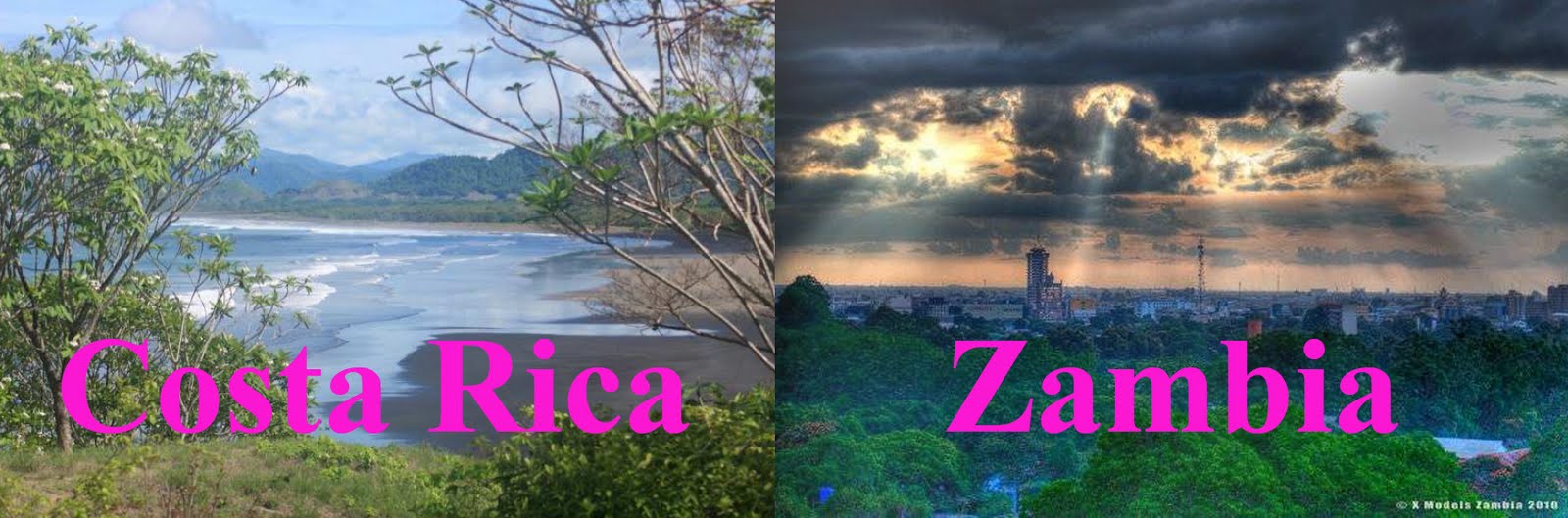
Petra and I are going abroad this summer for internships. We've worked for months to arrange these opportunities, but they've only become solidified very recently. I'm leaving on Wednesday, and Petra's leaving in a week. Many of you are asking: Where the heck are you going, and what they heck is it you'll be doing? Good questions!
Where Erika is going: Costa Rica. More specifically, the very rural ranch lodge at the Caletas-Ario Nature Reserve near Playa Ario on the Nicoya Peninsula on the western coast of the Central American peninsula. The property ranges from the dry plains to jungley forests to mangrove swamps to the beach, has myriad wildlife like monkeys and parrots and sloths and bats, and has very limited electricity and other modern amenities. Photo of the property above.
With whom: CIRENAS, Centro de Investigacion de Recursos Naturales y Sociales. The organization is a few years old, and is focused on making the best use of the plot of land which they donated to begin the large wildlife refuge. They have hosted a number of groups of academic researchers as well as American high school students who want to learn more about Costa Rica. CIRENAS is dedicated to protecting the land and using it as an environmental teaching tool. The Grew family, the driving force behind the preserve, seem utterly delightful and deeply in love with the land, and I truly look forward to working with them.
What Erika will be doing: Environmental Education NGO management consulting. More specifically, helping organize and make more efficient the administrative and managerial functions of a thriving new NGO, hoping to achieve things like an organizational chart, codified job descriptions, improved organizational communications logistics and website, a fundraising plan, etc.
****
Where Petra is going: Zambia, in the center of Africa. More specifically, she will be based in the modern fairly-developed capital city Lusaka (depicted above), and will travel to other districts where her host organization is currently running programs. She’ll be surrounded by quintessentially-African contemporary urban and traditional rural scenery, gorgeous fabrics, safari-worthy wildlife and the incomparable Victoria Falls.
With whom: FINCA. Founded in 1984, FINCA International is a recognized leader in microfinance and the pioneer of the village banking methodology. Microfinance is a sector within international development that provides financial services to disempowered people, usually women, who don’t have access to traditional financial tools and institutions. FINCA currently operates a network of 20 country programs in Latin America, Eurasia, the Greater Middle East and Africa, serving hundreds of thousands of clients.
What Petra will be doing: Microfinance program monitoring and evaluation. Prior to her work in the field, Petra will attend one week of training in Washington, D.C. Together with two local staff, she will spend 10 weeks conducting research and client interviews in Zambia. She will analyze the response data to determine poverty levels, program impact, and why clients join, remain with or exit the program. She will then present her findings to local management and produce a written report.
****
Yes, we're going to different places, and yes we'll miss each other terribly and will eagerly count down the minutes til we can be together again, but we wanted to be able to do what was best for each of us professionally, and it's only two months, so we can deal.
We'll do our best to post stories and pictures here, but no promises on frequency, since we'll both be somewhat disconnected from communications infrastructure. So don't worry if you don't hear from us. We promise full updates upon our return. Hope you all enjoy your summers!
sublet our NYC apartment!
Sublet our spacious furnished $1550/month 2-bedroom NYC apartment for the summer!
My wife and I will be abroad for June and July, and are looking for a responsible, tidy person/people to stay in our apartment for those two months, from June 1 to July 31. If you need, we might be amenable to starting as early as May 29th and/or extending through the first week of August.
Our apartment is at West 107th and Central Park West, just seconds to Central Park. It is a three minute walk to the 110th St B/C subway stop, a seven minute walk to the 110th St 1-line subway stop, a ten minute walk to the Columbia campus, and just minutes to groceries, gyms, laundromats, and other necessary amenities, as well as just minutes to perks like the famous Hungarian Pastry Shop and other cafes, bars, and the Cathedral of St. John the Divine. It’s a quiet, safe residential block in a homey, active neighborhood.
The apartment has windows in each room, a fire escape we use as a tiny balcony, and a lot of light, fresh breezes, and quietness. It has two bedrooms, one of which is set up fully as a bedroom with a double-sized bed, the other of which is set up mostly as a study but which does have a very comfortable twin-sized futon bed. There is also a living/dining room with a twin-sized couch and dining table that can comfortably sit six. There is a small kitchen with big sink, 4-burner stove and oven, microwave, toaster oven, full-sized fridge, and a full complement of nice dishes and cutlery, pots, pans, and anything else a good cook might want to use. The bathroom is small, in NYC fashion, but quite useable: shower, tub, toilet, sink, etc all in good working order, with lovely hot water pressure. There’s a friendly live-in superintendent in the building who is very responsive to any maintenance needs. We also have our own reliable high-speed wireless internet. Children are welcome. GLBTQ folks and people of all races, ethnicities, religions, etc. are welcomed. Sadly, no pets allowed. We currently have no pets so folks with allergies would be comfortable here, and we also don’t have any bedbugs, roaches, or any other nasties. A maximum of two people can live here.
So what’s the catch, you might ask, since this price is a steal for this size and location? Nothing much, and nothing bad. The place was unlovely when we moved in, but we’ve put in a lot of work making it quite pretty now. The linoleum tiles on the floors have a few cracked places, but is just an aesthetic concern you’ll hardly notice. When you bake something in the oven, you have to use the exhaust fan or else the smoke detector beeps. There’s not a lot of counter space. We have two bikes hung on the wall in the big bedroom (and you’re welcome to keep yours there too). The tub needs to be re-grouted, but works fine. There is not laundry in the building, nor a doorman or elevator, though it’s quite safe and secure. It’s a fourth floor walk-up. Other than that, it’s perfect by anyone’s standards.
The apartment would be best for a couple, and could also work for two separate tenants. Our neighbors include lots of families with small children, so we’re looking for people who aren’t loud night-owls or big partiers. We’re also obviously looking for people who are responsible, won’t trash our stuff, and will keep the place clean. We will need to interview any potential subletters, and have you sign an official subletting agreement. We will need the entire summer’s rent and utilities up front: the cost for the two months will be 3290: (1550 for rent, times two) plus (55 for electricity, times two) plus (40 for internet, times two). Any additional weeks at the beginning or end would be the same rate, pro-rated per day. Photos of the apartment are available at https://picasaweb.google.com/photoprince/PicsOf107thNYCAptForSublet?feat=directlink.
If you would like to view the apartment, please call Petra at 781-472-9293 or email her at petra.aldrich@gmail.com. We are available most days at most times from early morning through early evening. We will need to have a 100% commitment by May 29th at the absolute latest.
Wednesday, April 20, 2011
Living in the present
It seems that 93% of what Petra and I spend our time doing these days is planning for the future: Petra, through her studies and networking that are preparing her for her future career; myself, with my job search and recent grad school applications and soon with my own studies as well; and together continuing to try to prepare for our most treasured but hard-to-attain long-term hopes like starting a family and making a home somewhere. It's often hard to give ourselves permission to live in the moment we're in.
This past Saturday (thanks to some hard work planning ahead of time) I took some time off from my own life and helped lead a cleanup of a community garden in Brooklyn. The effort was part of Hands On New York Day, run by New York Cares (an excellent organization with whom I regularly volunteer, the NYC branch of the same org we went to New Orleans with). There were about 85 of us at the garden raking, painting picnic tables, fixing the greenhouse, and the like. As a leader there I didn't spend much time on any one task, but cruised around making sure everyone knew what they were doing, had what they needed, and that the work went smoothly and as intended.
This gave me the fun opportunity to meet just about everyone there: groups included a dozen sorority girls who were keen on tackling the dirtiest and heaviest jobs around while wildly gossiping, and a score of middle-management from an insurance actuarial firm who (reassuringly) worked methodically and with great care at all their tasks, from picking up sticks to weeding. Contrary to "community organizing" stereotypes, the vast majority of volunteers were black, not wealthy, and seemingly conservative: this has consistently been my experience at events like this. It was a delight to work with people who were such good workers and were so dedicated to helping others, and made me wish more white people, wealthy people, and liberals in this community were better at putting their whole selves where their mouths are (no offense to the exceptions to that statement).
I enjoyed a respite from responsibilities for a nice chunk of time when I decided (perhaps selfishly) that what most needed doing was keeping a lonely volunteer company: and so I found myself sitting on an upturned bucket with a truly delightful high-school freshman from New Jersey, sifting compost through some old window screens, commenting on everything from the squeamishness of men regarding worms and the glory of bowling and black and white photography to the degradation of Bella's character throughout the Twilight series. My hands smelled like life as I picked apart a soft dry twig, listening to the chickens warble and coo and the cool rain trickle from the leaves down onto the backs of my hands, the ground soft and rotting beneath my feet. My happiness in that moment, amidst the living fecundity and the bustle of selfless cooperative activity was like fertilizer to my heart, as well as a nourishing reminder of why I continue to commit myself to grassroots NGO work. And that, with herbs and chickens and the good kind of dirt, New York isn't always such a bad place to live.
This past Saturday (thanks to some hard work planning ahead of time) I took some time off from my own life and helped lead a cleanup of a community garden in Brooklyn. The effort was part of Hands On New York Day, run by New York Cares (an excellent organization with whom I regularly volunteer, the NYC branch of the same org we went to New Orleans with). There were about 85 of us at the garden raking, painting picnic tables, fixing the greenhouse, and the like. As a leader there I didn't spend much time on any one task, but cruised around making sure everyone knew what they were doing, had what they needed, and that the work went smoothly and as intended.
This gave me the fun opportunity to meet just about everyone there: groups included a dozen sorority girls who were keen on tackling the dirtiest and heaviest jobs around while wildly gossiping, and a score of middle-management from an insurance actuarial firm who (reassuringly) worked methodically and with great care at all their tasks, from picking up sticks to weeding. Contrary to "community organizing" stereotypes, the vast majority of volunteers were black, not wealthy, and seemingly conservative: this has consistently been my experience at events like this. It was a delight to work with people who were such good workers and were so dedicated to helping others, and made me wish more white people, wealthy people, and liberals in this community were better at putting their whole selves where their mouths are (no offense to the exceptions to that statement).
I enjoyed a respite from responsibilities for a nice chunk of time when I decided (perhaps selfishly) that what most needed doing was keeping a lonely volunteer company: and so I found myself sitting on an upturned bucket with a truly delightful high-school freshman from New Jersey, sifting compost through some old window screens, commenting on everything from the squeamishness of men regarding worms and the glory of bowling and black and white photography to the degradation of Bella's character throughout the Twilight series. My hands smelled like life as I picked apart a soft dry twig, listening to the chickens warble and coo and the cool rain trickle from the leaves down onto the backs of my hands, the ground soft and rotting beneath my feet. My happiness in that moment, amidst the living fecundity and the bustle of selfless cooperative activity was like fertilizer to my heart, as well as a nourishing reminder of why I continue to commit myself to grassroots NGO work. And that, with herbs and chickens and the good kind of dirt, New York isn't always such a bad place to live.
Subscribe to:
Posts (Atom)